
Most B2B teams can’t trace 40–70% of closed deals to a real source. Here’s how to fix marketing attribution without ripping out the stack you’ve built.
If you’re a B2B marketing leader, you’re almost certainly already doing the right things. The stack is in place. The campaigns are running. The dashboards load every morning. So when the attribution numbers don’t add up, when the board asks which channel drove the quarter and you can’t answer it cleanly, the instinct is to assume you’ve missed something. You probably haven’t.
Marketing attribution is the practice of identifying which marketing channels and touchpoints contribute to a sale. Most B2B teams have the tools to do this. Almost none of them fully trust the numbers those tools produce. The problem usually isn’t a missing platform, and it isn’t a skills gap on your team. It’s a structural gap in how the data connects.
That’s the part worth sitting with: it’s not your fault, and it’s not unusual. Every team running serious multi-channel marketing hits this same wall, because the standard stack was never built to connect into one view of the journey. And this matters: fixing it does not mean ripping out and replacing the tools you’ve already invested in. The fix is additive, not a rebuild.
If you’ve sat in a board meeting knowing the attribution slide was approximations dressed up as insight, this one’s for you. I’ll walk through the three failure modes we see most often, a quick diagnostic you can run today, and what a fixed attribution setup actually looks like in practice.
The “Boring Stack”
The typical B2B marketing stack looks complete on paper. HubSpot or Salesforce for CRM, GA4 for web analytics, Google Tag Manager for tag deployment, and two or three ad pixels across Meta, LinkedIn, and Google. This is what we call the Boring Stack. It’s boring because everyone has roughly the same setup and everyone has roughly the same blind spot. That’s the good news: this is a well-understood, well-mapped problem, not some exotic failure unique to your team.
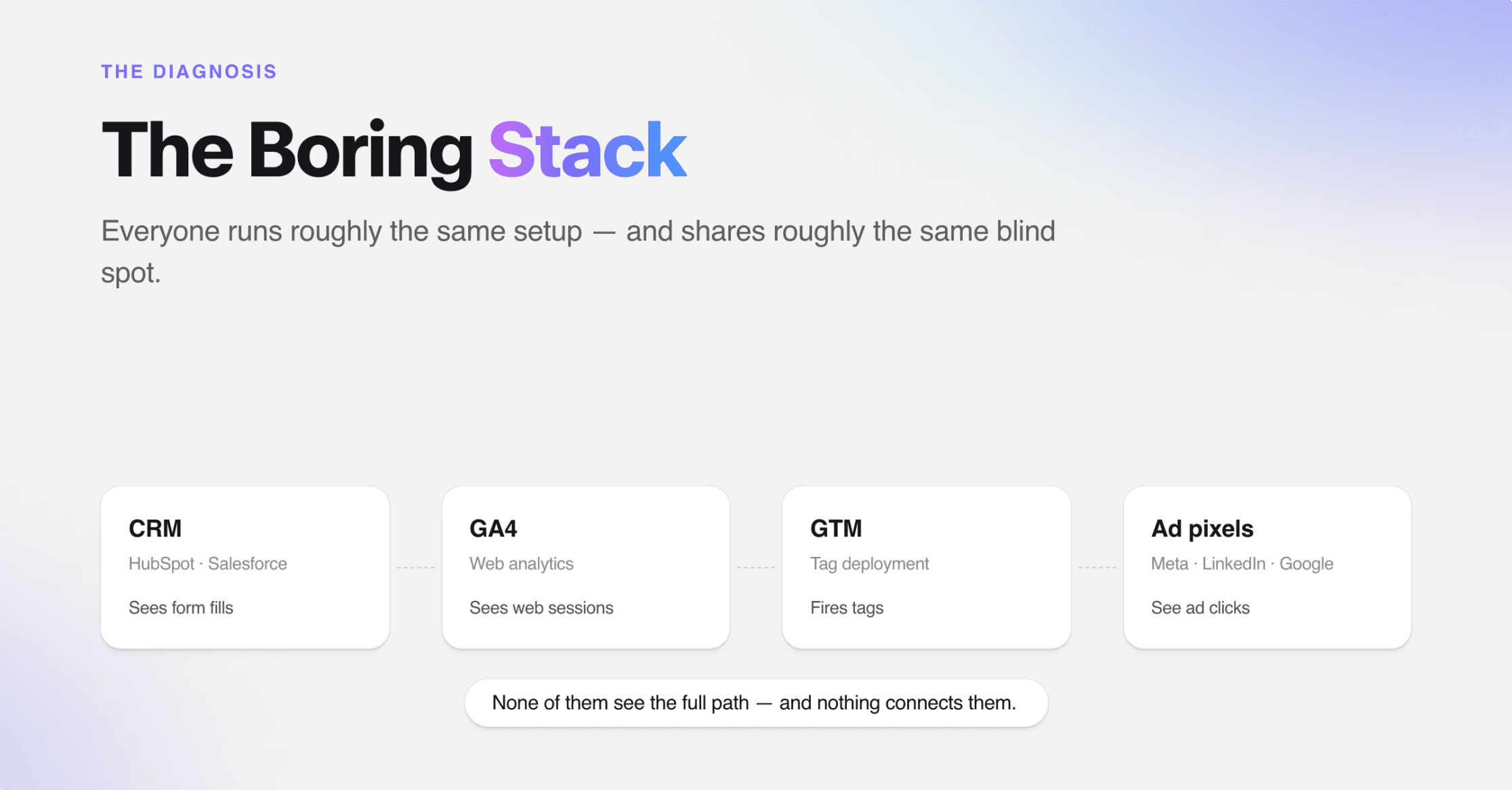
The issue isn’t that any individual tool is broken. Each one works fine in isolation. The issue is that nothing connects them into a single source of truth for the buying journey. GA4 sees web sessions. HubSpot sees form fills. LinkedIn sees ad clicks. None of them see the full path from first touch to closed deal. And when you try to reconcile the numbers across platforms, they contradict each other.
This isn’t a reporting problem, but rather an infrastructure problem.
Why this is getting worse in 2026
Google restructured GA4’s attribution reporting twice in the first half of 2026: once changing how traffic sources get grouped, then again changing what consent data GA4 is allowed to pass to Google Ads. If your attribution model treated GA4 as ground truth, the ground just moved under it. Again.
That’s not a reason to panic about GA4 specifically. It’s a reason to stop treating any single platform’s dashboard as the source of truth for attribution. A connected data layer doesn’t care which vendor ships an update this quarter, because it was never depending on one platform’s definition of a “source” in the first place.
Three ways attribution fails silently
B2B marketing attribution fails silently. The dashboard still loads, the numbers still update, and the board still gets a slide. But the data underneath is structurally unreliable in three specific ways most teams don’t catch until they audit properly.
1. Cross-channel double counting
A prospect clicks your LinkedIn ad on Monday. They Google your company on Wednesday and land on the site through organic search. They fill out a form on Friday after clicking a retargeting ad on Meta.
LinkedIn claims the conversion. Meta claims the conversion. GA4 attributes it to organic. Your CRM records it as a form submission with no source context. You’ve got one deal and three platforms each taking full credit. Every attribution report you build from these numbers overstates the contribution of every channel at once.
This is the default state for any B2B team running multi-channel paid without a customer data platform connecting the touchpoints. If it’s happening to you, you’re in the majority, not the minority.
2. Conversion-page tag-firing gaps
Tags fire on your homepage. Tags fire on your blog. But on the pages that actually matter for attribution (the pricing page, the contact page, the demo booking page), tag firing is often incomplete or misconfigured.
We audit dozens of B2B sites a year and this pattern shows up more often than it should. GTM looks healthy at the container level. But when you test the actual conversion pages, you find pixels that don’t fire, events that fire twice, and tags that fire on page load but not on the form submission that represents the real conversion.
The result: your analytics platform records the visit but misses the action. The gap between “someone visited the pricing page” and “someone requested a demo” is invisible.
3. Closed-won field decay
Pull up your CRM right now. Look at the last 10 closed-won deals. Check the Marketing Source field on each one. Count how many say “Direct,” “Unknown,” “Offline,” or are simply blank.
For most B2B teams doing this for the first time, the answer lands between 40% and 70%. That percentage is your blind-spot rate: the proportion of revenue you can’t attribute to a specific marketing channel.
This isn’t a data-entry problem, and it isn’t your sales team being lazy. It’s structural. When attribution infrastructure doesn’t connect CRM records back to the original touchpoints, the source field decays over time. Sales reps don’t fill it in because they don’t have the data. Marketing can’t backfill it because the connection was never made.
A 10-minute self-diagnosis
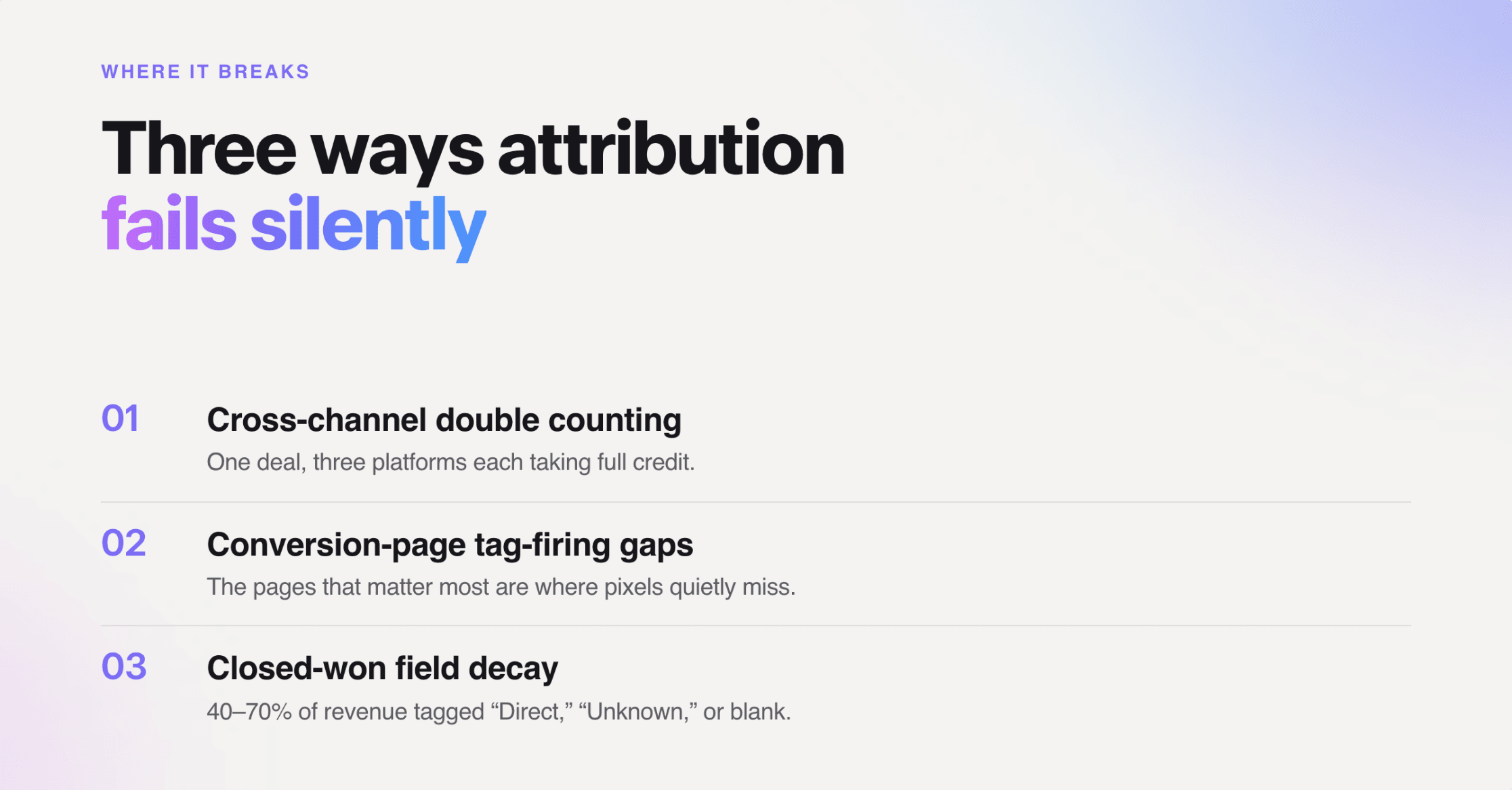
Finding out whether your attribution is broken is the easy part. You don’t need a big project or a full audit to get a first read. This diagnostic covers the three areas where B2B attribution fails most often. Run it today with the tools you already have.
Step 1: The closed-won field test (3 minutes). Open your CRM. Export the last 20 closed-won deals. For each, check the Marketing Source or Original Source field. Count the entries that are “Direct,” “Unknown,” “Offline,” or blank. Divide by 20. If the result is above 30%, your attribution has structural gaps.
Step 2: Check tag firing on your conversion pages (4 minutes). Open your pricing page, contact page, and demo booking page with a tag assistant active (Google Tag Assistant or GTM Preview Mode). Submit a test form on each. Verify that every pixel and event you expect actually fires on submission, not just on page load.
Step 3: Cross-check one deal across platforms (3 minutes). Pick your most recent closed-won deal. Find the company in LinkedIn Campaign Manager, Google Ads, and GA4. Check whether all three agree on when and how that company first engaged. If the first-touch dates and channels don’t match, your attribution data is contradictory.
A poor result here isn’t a verdict on your team. It’s the same thing we see on most stacks the first time anyone checks. It just tells you the gap is structural. And structural gaps are fixable.
Prefer to skip the manual version? Run our free Attribution Confidence Score right here. It maps your stack, checks whether your tags fire where money changes hands, and rates how reliably you can trace spend to revenue. It takes about two minutes, and no call is required.
Trouble loading the widget above? Run it directly at drewl.com/attribution-audit →
What “fixed” actually looks like
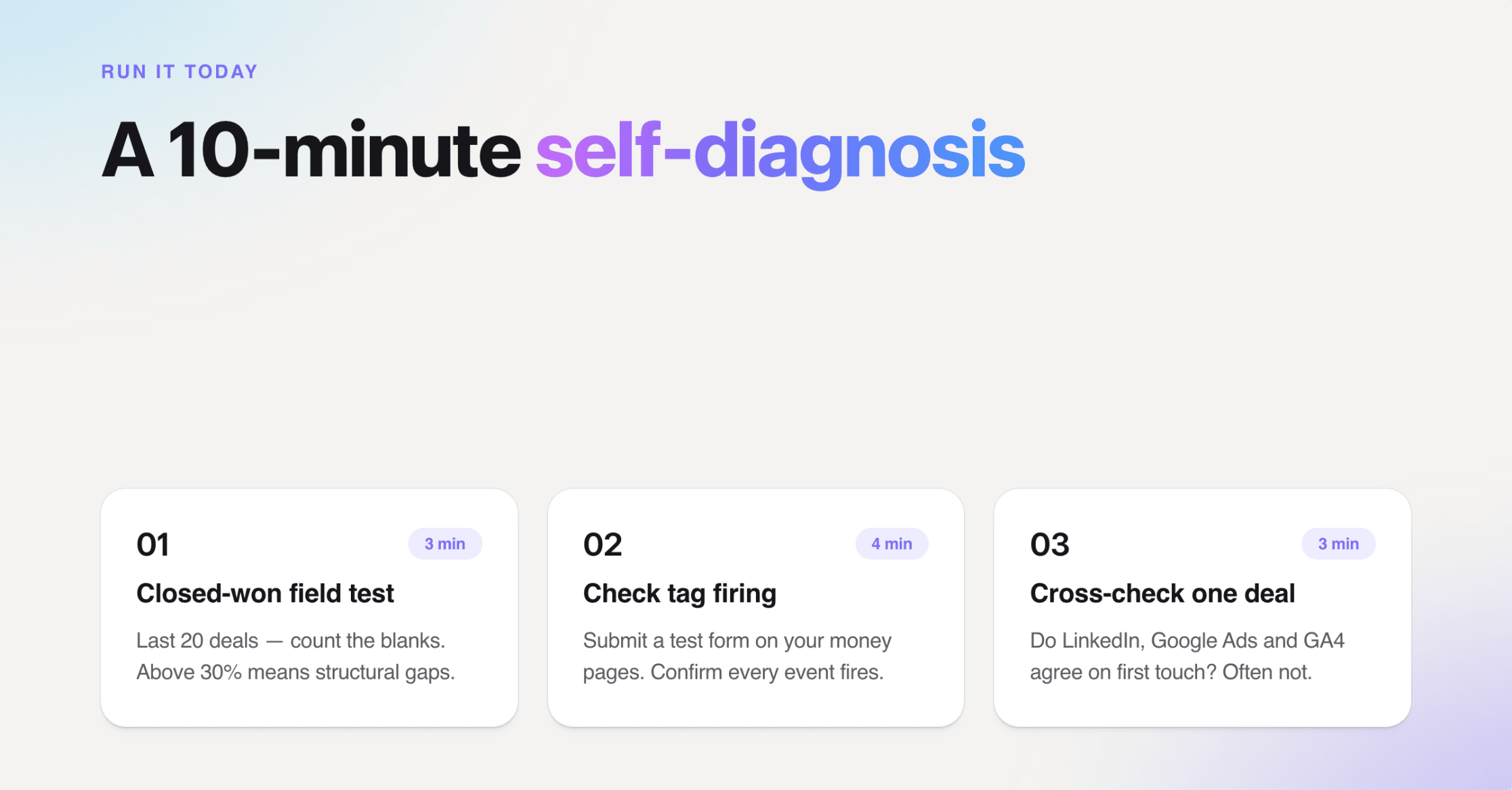
Fixed attribution means every closed deal traces back to a specific sequence of marketing touchpoints, with data you’d stake budget decisions on. It doesn’t require replacing your existing stack, and it doesn’t always require a build. Sometimes the fix is correcting what’s already there (a tag that isn’t firing, identity that isn’t resolving across channels); sometimes it’s adding the connective layer underneath.
The pattern we’ve seen work repeatedly is a custom customer data platform built around a data warehouse, with identity resolution connecting the touchpoints your existing tools track in isolation.
A real example: Android Authority. Android Authority serves 20M+ monthly visitors across a portfolio of media properties. Their attribution challenge was the same one most B2B teams face at scale: multiple channels, multiple platforms, no single view of the journey.
Drewl built a custom CDP from scratch: Google BigQuery as the warehouse, a proprietary event-collection SDK feeding data into the cdp.events table, and Hightouch for audience activation. Within hours of enabling event collection, 2,800 events had been ingested into the cdp.events table in BigQuery, resolving against real identities from day one.
The principle we apply on every attribution build: the warehouse sits upstream of everything. Reports, audience segments, and activation flows all pull from the same source of truth. When the data changes, every downstream output updates.
This isn’t an exotic approach. It’s the standard architecture for any team serious about attribution. What makes it work isn’t the novelty of the design. It’s the discipline of implementation: every event defined, every touchpoint mapped, every connection tested before the first report is generated.
You don’t have to replace the stack
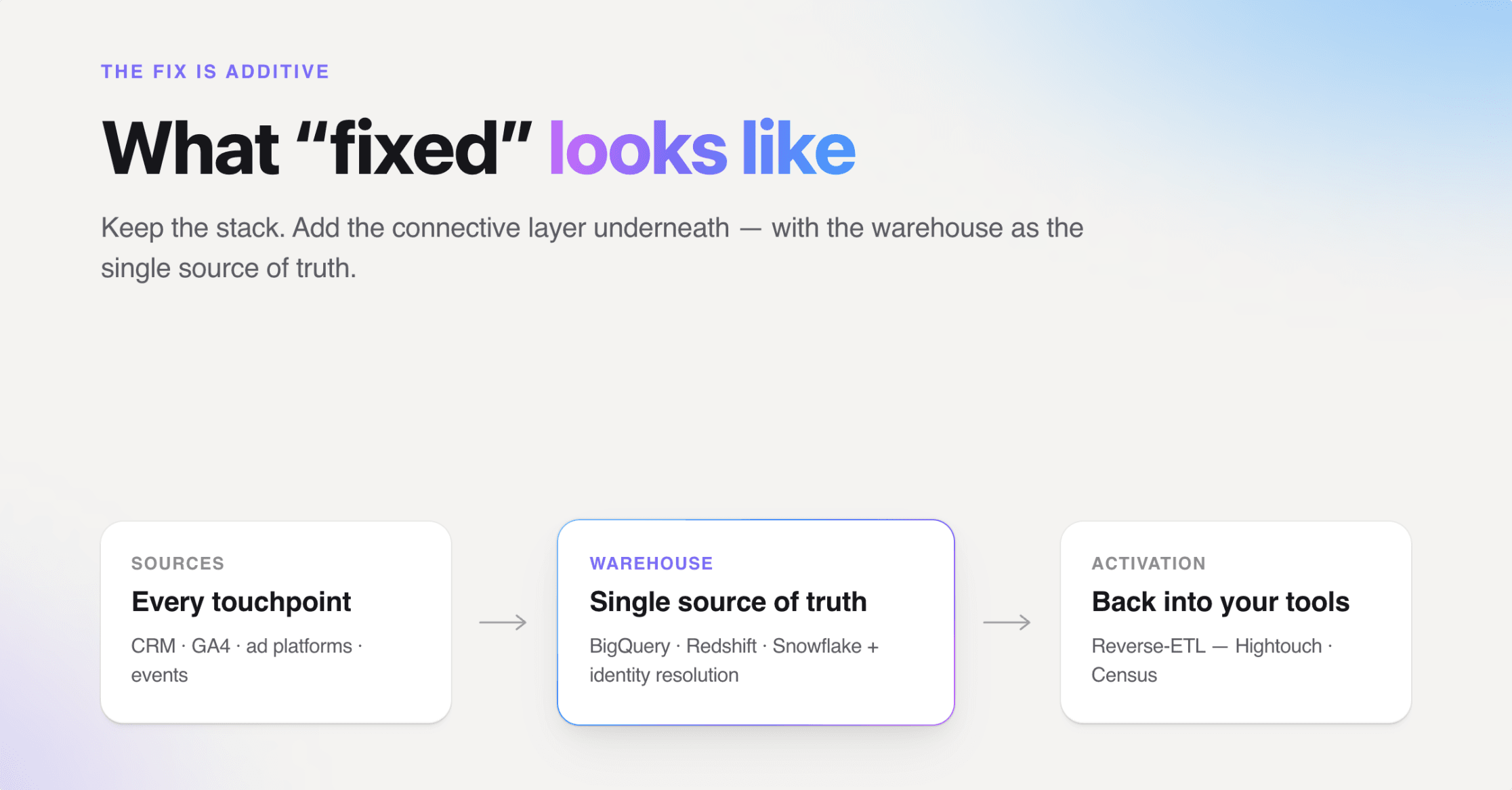
You don’t need to rip out HubSpot, cancel GA4, or migrate off Salesforce to fix attribution. The existing tools stay. What changes is the layer that connects them.
This is the reassuring part, and it’s worth saying plainly: we’re not here to put you through company rehab. The most common fear we hear when an agency gets involved is “rip and replace”: the belief that asking for help means tearing out everything you’ve built and starting over. That’s not what good attribution work looks like. We identify the gaps and build the missing connective layer. The stack you chose stays.
The other common misconception is that fixing attribution requires a six-figure infrastructure project and a year-long migration. For some organisations, particularly those with legacy data warehouses and deep vendor lock-in, that’s true. But for most B2B teams on a modern stack, the fix is architectural, not operational. And for plenty of teams it isn’t a build at all. The gap closes by correcting what’s already in place: a misfiring tag, broken identity resolution, an attribution model that never matched the buying cycle. We’d rather tell you that than sell you a platform you don’t need.
When a build is the right call, what you’re adding is a data-collection layer (the CDP), a warehouse (BigQuery, Redshift, or Snowflake), and a reverse-ETL tool (Hightouch, Census, or similar) to push unified data back into the tools your team already uses. Your CRM stays. Your ad platforms stay. GA4 stays. They just stop being the source of truth for attribution and start being consumers of a unified data model.
This is why we start with an Attribution Clarity Workshop rather than jumping into a build. Two days. Every touchpoint mapped, every gap identified, and a written architecture spec your team can act on. If it doesn’t surface at least two attribution blind spots you weren’t already aware of, it’s free.
You’re already doing the hard parts: the strategy, the campaigns, the spend. This is the one piece the standard stack leaves out, and it’s the most fixable piece of the lot.
→ Run your free Attribution Confidence Score: drewl.com/attribution-audit
Find out what you can’t currently track
Ready to find out how much of your budget you can’t tie to revenue? The Attribution Confidence Score maps your current setup, scores your attribution reliability, and shows exactly which revenue sources you can and can’t track, so you can see which channels are earning their spend and which are quietly burning it. It takes two minutes, and we add our analysis within one business day. No call required, nothing to buy.
→ Run your free Attribution Confidence Score: drewl.com/attribution-audit
Prefer to talk it through first? The first conversation is free. Dewey walks through your score with you, no charge and no obligation.
Book a call: cal.com/tayo-drewl/attribution-report-review