Three tests that tell you whether your data platform is actually working, or just storing data with a nice dashboard on top.
A customer data platform (CDP) is a system that collects first-party customer data from multiple sources, unifies it into a single customer profile, and makes that profile available to other tools for activation. That’s the textbook definition. The more useful question: is yours actually producing decisions, or is it a filing cabinet with dashboards on the front?
A CDP is the easiest thing in marketing to own and the hardest to admit isn’t doing anything. It gets bought to prove a team is serious about data, then quietly stops earning its keep. Someone called it the junk drawer of martech. Everyone throws data in; nobody owns what comes out. Dewey Robbins, who leads Drewl’s data team, uses three plain questions to tell a CDP worth keeping from one worth rebuilding. Here’s each one.
Three questions: Action, Audience, Direction
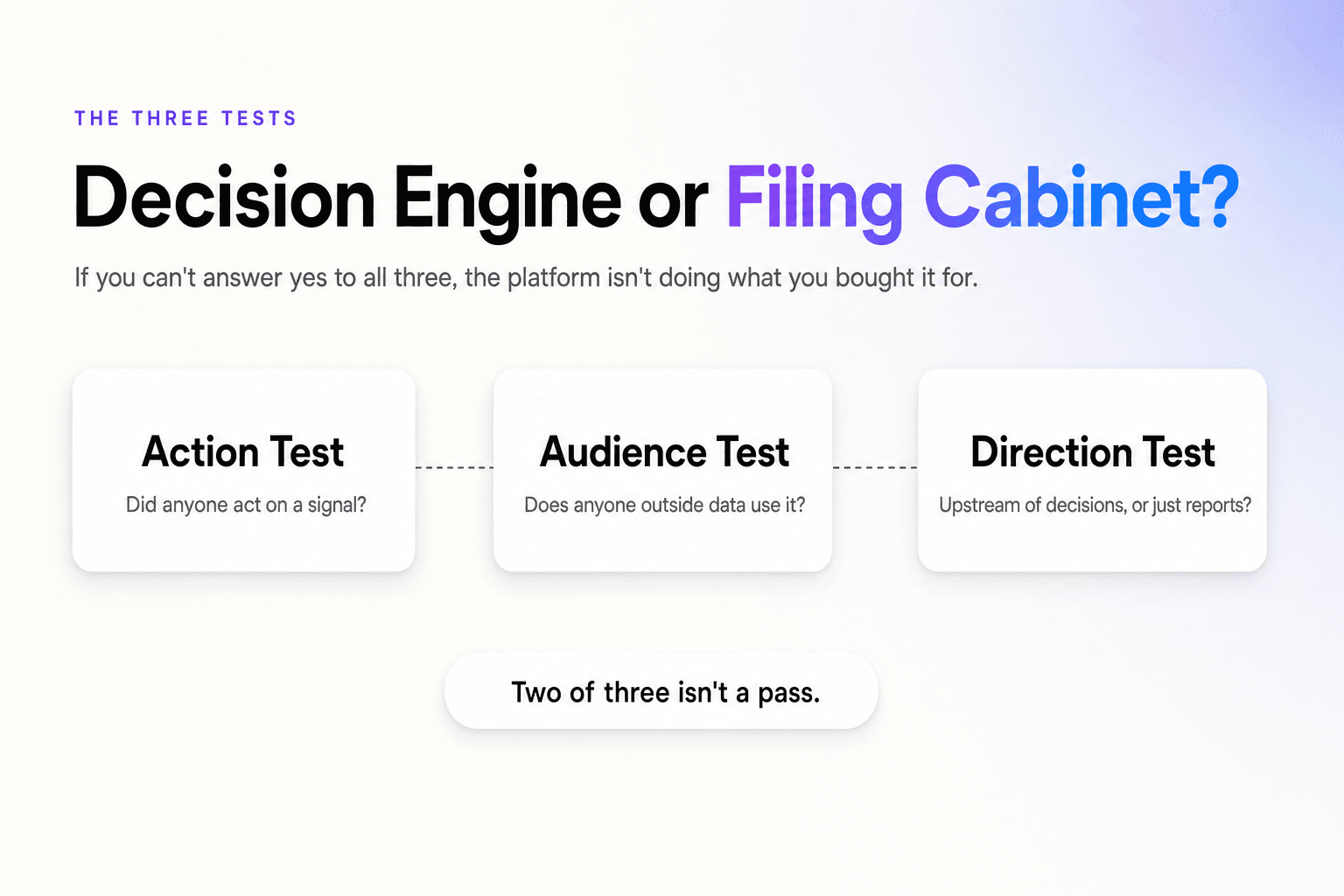
Three questions determine whether a CDP is a decision engine or a filing cabinet. If you can’t answer yes to all three, the platform isn’t doing what you bought it for.
1. The Action Test
When did anyone on your team last act on a CDP-derived signal?
Not “looked at a report.” Not “exported a CSV.” Acted. Changed a campaign. Paused a channel. Shifted budget. Triggered an automated sequence based on a segment the CDP identified.
If the last actionable decision someone made from CDP data was more than 30 days ago, the platform is a reporting tool. Reporting tools are fine. But they cost a fraction of what a CDP costs, and they don’t pretend to be infrastructure.
A CDP that doesn’t trigger action still costs engineering time, data team bandwidth, and licence fees. All of that spend produces the same output as a well-configured GA4 property. If that’s the current state, the honest move is to either rebuild the CDP so it feeds decisions, or stop paying for it.
2. The Audience Test
Does anyone outside the data team open the CDP dashboard?
CDPs that only the data team uses are filing cabinets with a very expensive lock. The whole point of a customer data platform is that it makes customer data accessible to the people who need it: marketing for segmentation, sales for account intelligence, product for feature prioritisation.
If the only people who interact with the CDP are the people who built it, you’ve got a data warehouse with a user interface. That’s not nothing, but it’s not a CDP either. A working CDP pushes audiences to your ad platforms, triggers email sequences, updates CRM records, and serves personalised content. The data team builds it; everyone else uses it.
3. The Direction Test
Is the warehouse upstream of any decision system, or only upstream of reports?
This is the test that separates architecture from tooling. In a properly built data infrastructure, the warehouse (BigQuery, Redshift, Snowflake) sits upstream of everything: your CRM, your ad platforms, your email tool, your personalisation layer. Data flows from collection into the warehouse, gets unified and modelled there, and then flows out to every system that needs it.
In most B2B setups, the warehouse sits at the end of the chain. Data flows in from various tools, gets stored, and produces reports. The reports go into a slide deck. The slide deck goes into a meeting. The meeting produces a decision that someone then manually implements in the original tools.
That’s the filing cabinet pattern. Data goes in, gets organised, and sits there until a human extracts it. The decision engine pattern is the reverse: data goes in, gets modelled, and automatically flows out to the systems where decisions execute.
Why this matters more in B2B
B2B buying cycles involve more stakeholders, longer timelines, and more channels per deal than B2C. A CDP that can’t resolve identity across those channels leaves you running multi-stakeholder attribution on fragments, which is no attribution at all.
The core challenge is identity resolution at scale across long timelines. A single B2B deal might span many touchpoints over three months. A procurement lead researches on mobile. A technical evaluator clicks a LinkedIn ad on desktop. A decision-maker replies to an email. That’s three people, three devices, and three channels feeding one opportunity. If the CDP can’t pull those into a single account view, every downstream signal is fragmented.
Multi-stakeholder journeys compound the problem. In B2C, identity resolution means connecting one person across sessions. In B2B, it means connecting multiple people across sessions, devices, and roles within one account, then stitching those profiles into a buying-group view sales can actually act on. CDPs that weren’t architected for this (which is most of them) produce individual-level profiles that miss the account-level story entirely.
The cost shows up in three ways. Marketing budget gets misallocated, because signals from different stakeholders aren’t connected. Opportunities get missed, because buying-group activity isn’t routed to sales in time. And strategic decisions get made on incomplete data, because the board slide shows individual touchpoints, not the account journey.
Find out whether your current stack passes these three tests. Run the Attribution Confidence Score below. It maps your setup and shows exactly where the connections are missing.
Trouble loading the widget above? Run it directly at drewl.com/attribution-audit →
What changes when the CDP sits upstream of decisions
When a CDP sits upstream of decisions, every downstream tool gets smarter. The CRM shows enriched profiles. The ad platforms receive suppression lists and lookalike audiences built from real conversion data. The email tool triggers sequences based on behavioural signals rather than static lists.
A real example: Android Authority. Drewl built Android Authority’s CDP from scratch: a custom event collection SDK feeding Google BigQuery, with HighTouch handling audience activation. The setup serves 20M+ monthly visitors. Within hours of switching on event collection, 2,800 events landed in the BigQuery events table, structured and queryable for everything downstream.
The key architectural decision: BigQuery sits upstream. Every reporting view, every audience segment, and every activation flow pulls from the same warehouse. When the data model changes, everything downstream updates automatically. There’s no manual reconciliation between platforms, no conflicting numbers across tools, and no attribution slide built from approximations.
We’ve applied the same pattern for an enterprise e-commerce business (replacing a legacy proprietary attribution setup with a modern, warehouse-first one) and for a global pharmaceutical company moving from fragmented analytics to a single unified infrastructure. Different industries, same underlying architecture.
This isn’t an exotic approach. It’s the standard architecture for any team serious about attribution. What makes it work isn’t the novelty of the design. It’s the discipline of implementation: every event defined, every touchpoint mapped, every connection tested before the first report is generated.
Four B2B CDP failure modes
Most B2B CDP implementations fail for architectural reasons, not tool reasons. The platform works fine. The implementation doesn’t produce decisions. These are the four failure patterns we see most often, and they’re all fixable without replacing the platform itself.
1. The dashboard graveyard. The CDP was set up to produce dashboards. The dashboards were impressive at launch. Six months later, nobody opens them. The data team maintains them out of obligation. No decisions flow from them. The platform has become a reporting tool that costs far more than a reporting tool should cost.
2. The identity gap. The CDP collects events but can’t resolve identity across devices, sessions, and channels. A prospect who visits the site on mobile, clicks a LinkedIn ad on desktop, and submits a form through email looks like three separate people. Without identity resolution, the “unified customer profile” is actually three fragmented profiles that happen to share a database.
3. The warehouse island. Data flows into the warehouse but nothing flows out. BigQuery or Redshift holds structured, modelled, queryable data, and the only thing that queries it is a BI tool that produces weekly reports. The warehouse isn’t connected to activation tools, so the data never reaches the platforms where decisions execute.
4. The vendor lock trap. The CDP was purchased as a vendor product (Segment, mParticle, Adobe) but configured by a team without the data architecture expertise to make it work. The tool is powerful. The implementation is surface-level. The vendor’s documentation covers features; it doesn’t cover how those features should map to your specific buying cycle. The result is a platform that technically works but doesn’t produce the output your team actually needs. We see this one a lot. The fix is usually architectural, not financial.
Frequently asked questions
Find out whether your data infrastructure passes the three tests
The Attribution Confidence Score maps your current stack, shows where the data connections are missing, and what the gaps are costing in invisible pipeline. Two minutes. Our analysis within one business day.
This matters more this year. Everyone wants to point AI at their marketing data. A smart tool on messy data just gives you wrong answers faster. Fix the source first.
→ Run your free Attribution Confidence Score: drewl.com/attribution-audit
Already know the infrastructure needs fixing? The 90-Day Quick-Win Plan that comes out of the Attribution Clarity Workshop identifies three changes you can make in your current stack before any new build starts. Dewey leads every Workshop personally. Maximum 3 per month.
Book a Workshop conversation: cal.com/tayo-drewl/attribution-report-review